With Decree No. 127/2026/NĐ-CP establishing Vietnam’s first national legal framework for the Halal sector, the question facing each locality is no longer “whether to participate,” but “how ready it is.” For Khánh Hòa — the province that recently hosted the Vietnam Halal Tourism Conference 2026 — the answer presents a two-sided picture: clear resource advantages, but a remaining gap in supply chain standardization that still needs to be closed.
A strong starting point: a rare multi-sector ecosystem
What sets Khánh Hòa apart from many other localities is not any single product or form of tourism, but its ability to connect multiple sectors within the same development space: seafood, edible bird’s nest products, sea grapes, coffee, agricultural produce, and products from goats and sheep — most of which already have stable export markets and modern processing systems. This is a foundational advantage that not every province or city possesses when entering the Halal economy.
Seafood: the greatest advantage, but advanced processing remains a bottleneck
Seafood is a key industry in Khánh Hòa, generating approximately USD 839 million in exports each year, and many businesses have already obtained Halal certification. However, this advantage does not yet translate into comprehensive competitiveness. Fresh seafood is generally regarded as Halal by default, but highly processed products such as canned tuna and fish cakes must still demonstrate the Halal origin of cooking oils, seasonings, and preservatives used in production. This is the technical bottleneck that has prevented the province from fully capturing the added value of advanced processing — a higher-margin segment than the export of raw materials — in proportion to the scale of the industry.
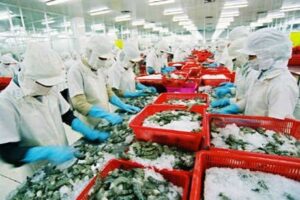
Khánh Hòa seafood — the province’s largest export sector, with substantial room remaining to increase added value through advanced processing.
Edible bird’s nests and sea grapes: niche advantages that need a compelling brand story
Edible bird’s nest products and sea grapes represent a different path: competing not through volume, but through value per unit. Edible bird’s nests enjoy strong demand in premium Muslim markets such as the UAE, Qatar, and Saudi Arabia, while sea grapes align with the green consumption trend spreading among younger Muslim consumers. Yet both face the same challenge: to command premium prices in the Middle East, products need a credible story of origin and independently verified processes — something Halal certification alone cannot fully communicate without a corresponding brand-building strategy.

Swiftlet farming — a premium advantage for Khánh Hòa, but one that requires a brand strategy to compete in Middle Eastern markets.

A sea-grape processing enterprise in Khánh Hòa — a green product aligned with the consumption trends of a new generation of Halal consumers.
Goats and sheep: a long-term strategic bet
Khánh Hòa is one of the few localities in Vietnam to have issued a plan to develop goat and sheep products into Halal products by 2030 (Decision No. 1801/QĐ-UBND dated May 29, 2026). The plan aims to create a closed value chain encompassing breeding stock, animal husbandry, slaughter in accordance with Halal procedures, processing, and export. This is a different direction from that of most coastal localities, which focus primarily on seafood. It is also a field that requires long-term investment in centralized slaughter facilities that comply with Sharia requirements — a type of infrastructure that is virtually nonexistent at an industrial scale in Vietnam.

Goat and sheep farming — a long-term strategic direction for Khánh Hòa that requires investment in Sharia-compliant slaughter infrastructure.
Local infrastructure and legal framework: necessary, but not sufficient
Institutionally, Khánh Hòa has moved one step ahead. Plan No. 7561/KH-UBND, implementing Decree No. 127/2026/NĐ-CP, was issued almost in parallel with the Government’s decree, demonstrating a faster-than-average policy response. The province also has a system of seaports, an international airport, and economic zones capable of supporting logistics chains and dedicated cold-storage facilities for Halal goods. However, legal and transport infrastructure are only necessary conditions. The sufficient conditions — domestic Halal certification bodies that are bilaterally recognized by importing markets, together with a workforce knowledgeable about Sharia standards in quality control — remain gaps that no single locality can resolve on its own.
At the Halal Economic Forum on July 8, 2026, several concrete steps were taken to narrow this gap. Halal Hub Vietnam signed a memorandum of understanding with the Spanish Halal Food and Quality Certification Organization, alongside agreements between Vietravel and HALCERT, and between DT Food and Lotus Planet Singapore. The common objective of these agreements is to build an integrated Halal ecosystem — connecting logistics, certification, and markets — rather than pursuing isolated certification projects, which are unlikely to create a sustainable competitive advantage on their own.
Conclusion
Khánh Hòa has the resources to become a Halal hub for Vietnam’s South Central Coast — but resources are only the raw material for a much longer story of competition. Malaysia does not lead the global Islamic economy because of its natural resources, but because its JAKIM standards system has been widely recognized for decades. That lesson suggests that Khánh Hòa’s real challenge is not what it has to sell, but whether it can build a system trustworthy enough for the Muslim world to believe that what is being sold is genuinely Halal — from breeding stock to the dining table, and from farms and aquaculture areas to supermarket shelves in the Middle East.
Sources: Khánh Hòa Online Newspaper, Nhân Dân Newspaper, Doanh nghiệp Hội nhập, and the Government Electronic Information Portal.